Price hits your stop, takes you out — and then goes exactly where you expected. Sounds familiar? Most of the time it is not "stop hunting" or bad luck: the stop simply sat inside the normal price movement. We measured, across 44 coins over 230 days, how often the market hits a stop at different distances — and where to place it so it protects you from being wrong, not from noise.
Why your stop-loss keeps getting hit
Price does not move in a straight line. Even when the trade idea is right, the market pulls back along the way — that is noise. If your stop is closer than the coin's normal pullback, a random swing takes it out and you lock in a loss on a trade that would have worked.
The most common mistake is a stop "in percent from the gut": 1%, 2%, 3% for any coin. But coins behave differently. Bitcoin moves about 2.2% in one direction within 3 days half of the time, while a typical altcoin moves noticeably more. The same percentage stop on different coins is a completely different risk.
How often a stop gets hit: the data
We took every hour over 230 days and checked whether price reached a level X% against the position within one day or three days. That is the chance a stop at that distance fires — regardless of whether the idea was right.
| Stop | BTC, 24h | BTC, 72h | ETH, 72h | SOL, 72h | Typical alt, 72h |
|---|---|---|---|---|---|
| 1% | 56% | 76% | 82% | 84% | 86% |
| 2% | 28% | 54% | 63% | 67% | 72% |
| 3% | 14% | 36% | 48% | 53% | 60% |
| 5% | 4% | 15% | 25% | 31% | 40% |
| 10% | 0.1% | 2.2% | 6.3% | 8.2% | 12% |
- A 1–2% stop on a multi-day trade is a coin flip or worse. On altcoins a 2% stop gets hit in 72% of cases within 3 days.
- A 5% stop on Bitcoin gets hit within 3 days in about one trade out of seven (15%); on a typical alt — in 40%. Coins differ, so stops must differ.
- The longer you hold, the wider the stop must be. A 2% Bitcoin stop gets hit within a day in 28% of cases, within three days in 54%.
Stop hunting or just noise?
The feeling that "the market came exactly for my stop" is understandable: a stopped-out trade sticks in memory, winners do not. But the numbers above contain no intent at all — it is just price range. If a stop sits where price goes half the time, it fires half the time. Move the stop out of normal noise first, and only then look for conspiracies.
ATR stops: good idea, usually too close
A popular rule is a stop 1–2 ATR from entry. ATR (Average True Range) measures the average candle and reflects the coin's character — better than a fixed percent. But the ATR of an hourly chart describes one candle, and a trade lives for dozens of them.
| Stop in hourly ATR | Hit within 24 hours |
|---|---|
| 1 ATR | 74% |
| 1.5 ATR | 61% |
| 2 ATR | 51% |
| 3 ATR | 33% |
| 5 ATR | 13% |
A 1.5-ATR stop takes out more than half of trades within the first day. ATR answers "how far did price move per candle", but a stop needs a different answer: how far price can travel while the trade is open.
Where to put the stop: beyond the normal move
That is what TPR-72 (True Path Range) answers: for each of 44 coins it calculates the range price stays inside over the next 72 hours with ~80% and ~50% probability, based on the coin's current volatility and how far it travelled at similar volatility over the last 180 days.
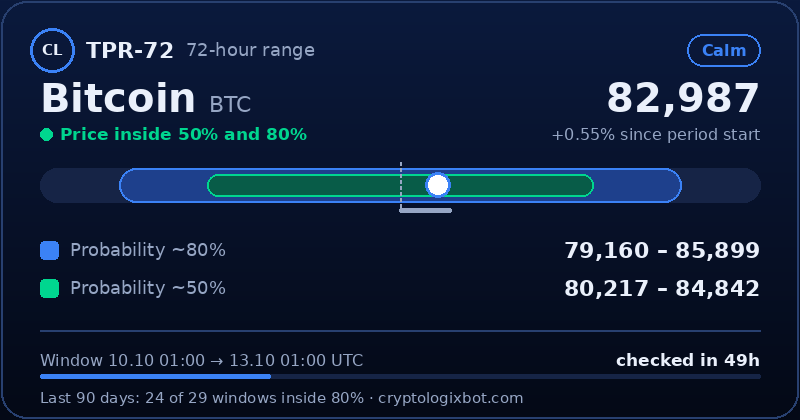
Live Bitcoin example. The 80% bound is now ±3.9%, the 50% bound ±2.7%. A stop at the 50% bound gets touched within 72 hours in about 25% of cases, a stop beyond the 80% bound in about 10%. Only 1.2% further away — and 2.5× fewer random stop-outs.
The rule is simple: put the stop beyond the 80% bound, not inside the 50% range. Inside 50% price moves all the time — a stop there catches noise. Beyond 80% price rarely goes — and if it does, the scenario really is broken.
The numbers change: in calm markets the range is narrower, in volatile ones wider. That is why "always 3%" does not work: today it is beyond the noise, next week it is in the middle of it.
"But a wider stop means a bigger loss"
Not if you size the position from risk. The position is sized so that the stop costs a fixed amount — say, 1% of the deposit.
Deposit $1,000, risk 1% = $10. A 1% stop → a $1,000 position, a 4% stop → $250. Either way the stop costs $10. But on an altcoin the first stop gets hit within 3 days in 86% of cases, the second in 49%.
What no calculation protects you from
About once every 2–3 weeks the whole market makes a joint move — news, a regulator’s decision, a liquidation cascade. On such days almost every coin breaks its range at once. Such a move cannot be predicted in advance — we tested dozens of features. That is why a stop is always needed, and several same-side positions across altcoins are one big position. See how it looks.
Checklist: stop-loss before entry
- The stop sits beyond the coin's normal move for the trade's horizon (for 3 days — beyond the TPR 80% bound), not "2% as always".
- Position size comes from risk: a stop-out costs no more than 1–2% of the deposit.
- Leverage keeps liquidation beyond the stop.
- If a stop beyond the noise makes the position too small, the trade is not worth the risk — do not move the stop closer.
- Several positions on the same side — count the total risk, not each one.
Method. Hourly Binance USDT-M futures candles for 44 coins over the last 230 days. A window starts at every hour; "price reached the level" means at least one candle touched it with its high or low. Longs and shorts are counted together. "Typical altcoin" is the median across all coins. This describes the past market, not a promise about the future.
Check your own trade
The TPR-72 calculator shows a stop beyond the noise, position size from your risk, safe leverage and the chance price reaches your level. Free, no sign-up.
Open the calculator →Telegram botFAQ
Where should I put a stop-loss in crypto?
Beyond the coin's normal move for the trade horizon. For a 2–3 day trade — beyond the range price stays in with ~80% probability (TPR-72). A stop inside the 50% range gets hit by normal noise in roughly every second to fourth trade.
Why does my stop get hit and then price goes my way?
Because the stop was closer than the coin's normal pullback. A 2% stop on Bitcoin gets hit within 3 days in 54% of cases, on a typical altcoin in 72% — whether the idea was right or not.
What stop-loss should I use for Bitcoin?
It depends on volatility and the trade horizon. Right now Bitcoin's 72-hour 80% bound is about ±3.9%; a stop beyond it gets touched in about 10% of cases. The current value is on the TPR-72 page, updated every hour.
Is an ATR-based stop-loss correct?
It is better than a fixed percent, but 1–2 ATR on the hourly chart is too close for a multi-day trade: a 1.5-ATR stop gets hit within a day in 61% of cases.
Doesn't a wider stop mean a bigger loss?
No, if you size the position from risk: position = deposit × risk ÷ distance to stop. Then every stop-out costs the same amount, and noise hits it far less often.